
Technical information : The solar radiation
The solar spectrum consists of three wavelength families:
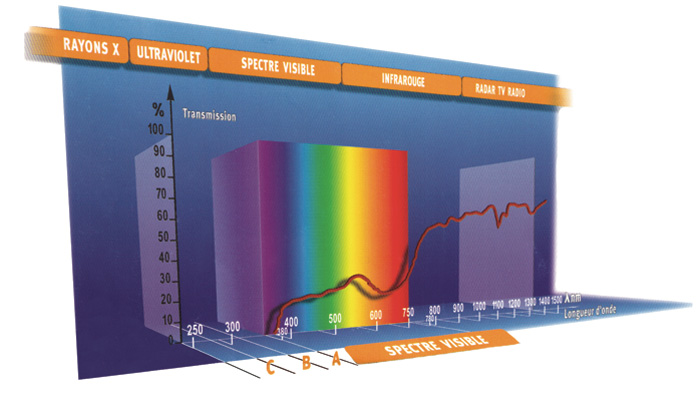
Ultraviolet rays or UV from 100 to 380 nanometers
They are not perceptible by the eye. They are nevertheless the most harmful and are divided into 3 types:
- UVA (315 to 380 Nm) are the principal cause of the eye ageing
- UVB (280 to 315 Nm), harmful, they are at the origin of sunburn
- UVC (100 to 280 Nm), are the most dangerous for the eye. They are luckily filtered through the ozone layer.
“UV400” appellation guarantees a 100 % protection against these radiations. However, the proportion of UV increases according to the solar intensity radiation. Altitude, light and reflection play a crucial role in choosing the appropriate lens.
The visible light from 380 to 780 nanometers
It corresponds to different eye visible colours and breaks down as following:
- 380 - 500 Nm: purple-blue
- 500 - 600 Nm: green-yellow
- 600 - 780 Nm: orange-red
Infra-reds between 780 and 2000 nanometers
Imperceptible, they are responsible for a warming and drying phenomenon. Although not very dangerous, they can cause some damage to the eye, following a too intense sun exposure